Overview
Several CAPO oracles (Capped Oracles) in the Venus BNB Core pool were set when yields were much higher than today. A cap set too far above actual yield lets a manipulated exchange rate rise further before the CAPO cap stops it. VIP-683 lowered the CAPO growth rate on sUSDe, WBETH, slisBNB and asBNB, and the snapshot gap on slisBNB and asBNB, following our analysis. This post sets out the method and data behind those values.
Background
Venus introduced CAPO (Correlated Asset Price Oracle) in May 2025 to price tokens that are structurally tied to an underlying asset, such as sUSDe to USDe, or a liquid staking token to its base token. Such a token’s exchange rate against its underlying should only rise slowly, at some roughly anticipated yield. CAPO uses this to cap how fast the rate can grow, measured from a snapshot of the rate plus a small buffer (the snapshot gap). A manipulated rate could inflate asset values only up to the cap. This protects the market most effectively when it is close to the actual yield, meaning that growth rate parameters need to be updated as yields change.
| Asset | Growth rate change | Snapshot gap change | Headroom |
|---|---|---|---|
| sUSDe | 28.3% → 15% | 2.2% (no change) | 4.18% → 3.08% |
| WBETH | 4.64% → 3% | 0.38% (no change) | 0.55% → 0.42% |
| slisBNB | 5% → 2% | 0.35% → 0.17% | 0.71% → 0.28% |
| asBNB | 5% → 2% | 2.5% → 0.17% | 2.90% → 0.32% |
Headroom is how far a manipulated exchange rate could rise above the true rate before the cap stops it, 30 days after a snapshot, if yield stays at its past-year level. Headroom grows each month a snapshot is not refreshed.
Method
We set the growth rate to the highest 15-day annualised yield over the past year, rounded up to the next 0.5%, with a 2% floor. For slisBNB and asBNB we also cut the snapshot gap to one month of growth at the new rate. The 30-day snapshot interval stays the same for all four assets. sUSDe is an exception: it is set at 15% rather than the formula’s 5.5% (see below).
| Asset | Yield, past year | Highest 15-day yield | Formula result |
|---|---|---|---|
| sUSDe | 4.3% | 5.3% | 5.5% |
| WBETH | 2.5% | 2.8% | 3% |
| slisBNB | 0.6% | 1.2% | 2% |
| asBNB | 0.1% | 1.6% | 2% |
sUSDe
sUSDe yield is driven by funding rates, which can rise quickly in a bull market when long positions are crowded. Our method gives a growth rate of 5.5%, but sUSDe is set at 15% so a sudden return to bull-market conditions does not cap its growth. The highest 30-day yield since February 2025 is 10.0%, but it reached 32% in April 2024.
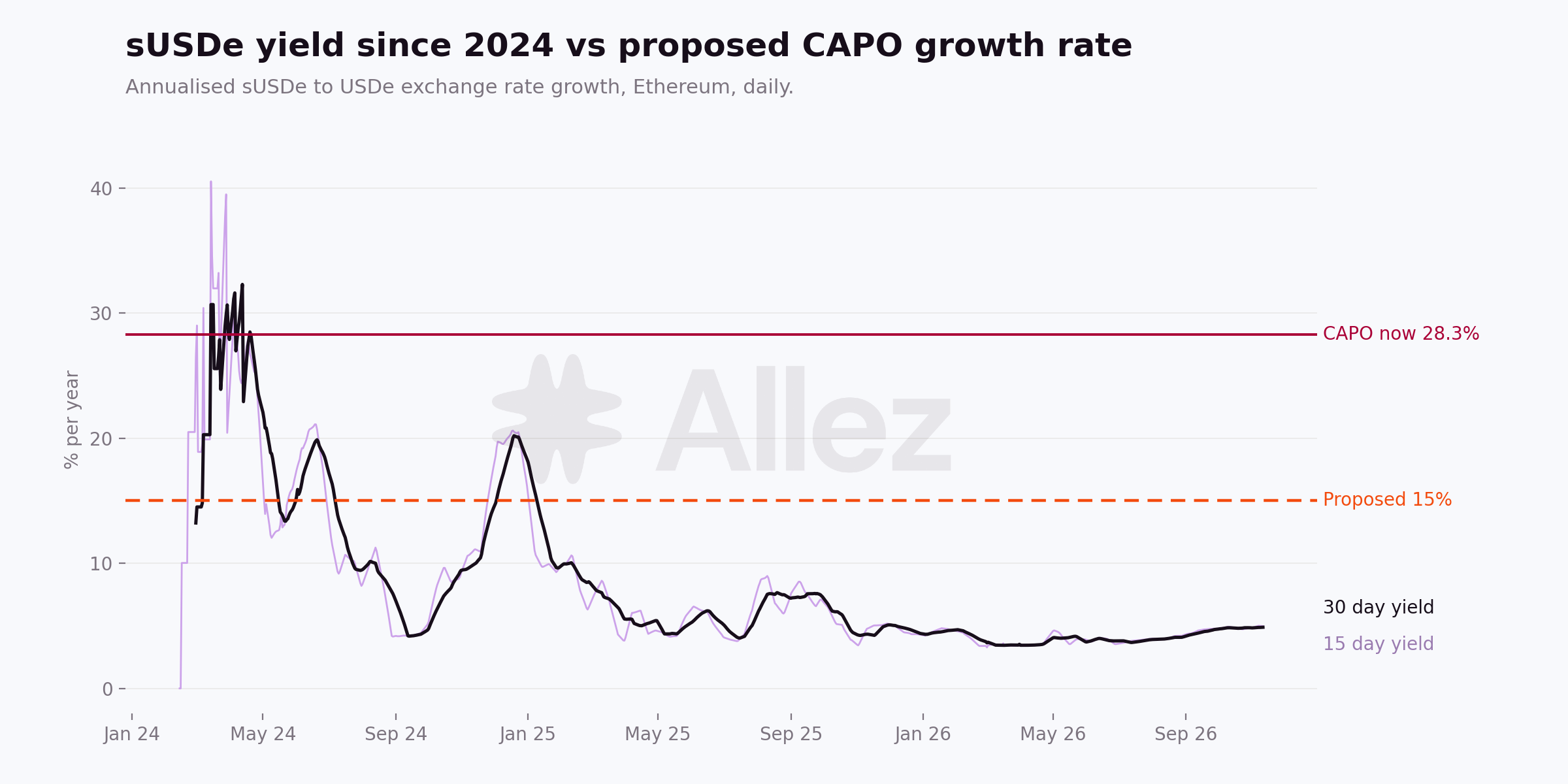
sUSDe annualised yield since February 2024 against the previous 28.3% and new 15% growth rates.
slisBNB and asBNB
slisBNB is the largest LST on BNB and the yield it has captured has fallen dramatically as BSC gas fees, which fund staking rewards, have been cut. Over the past year, it has had an average APY of 0.6% with a max APY of 1.2% over a 15 day period. Since yield has fallen sharply and is expected to stay low, the growth rate is now 2% and the snapshot gap was cut from 0.35% to 0.17%, one month of growth at 2%.
asBNB is priced in slisBNB, so it passes through both CAPOs. The asBNB/slisBNB rate has moved twice in the past year, by about 0.06% each time. Its 2.5% gap is about 40 times the largest move, so we cut it to 0.17%, one month of growth at 2%.
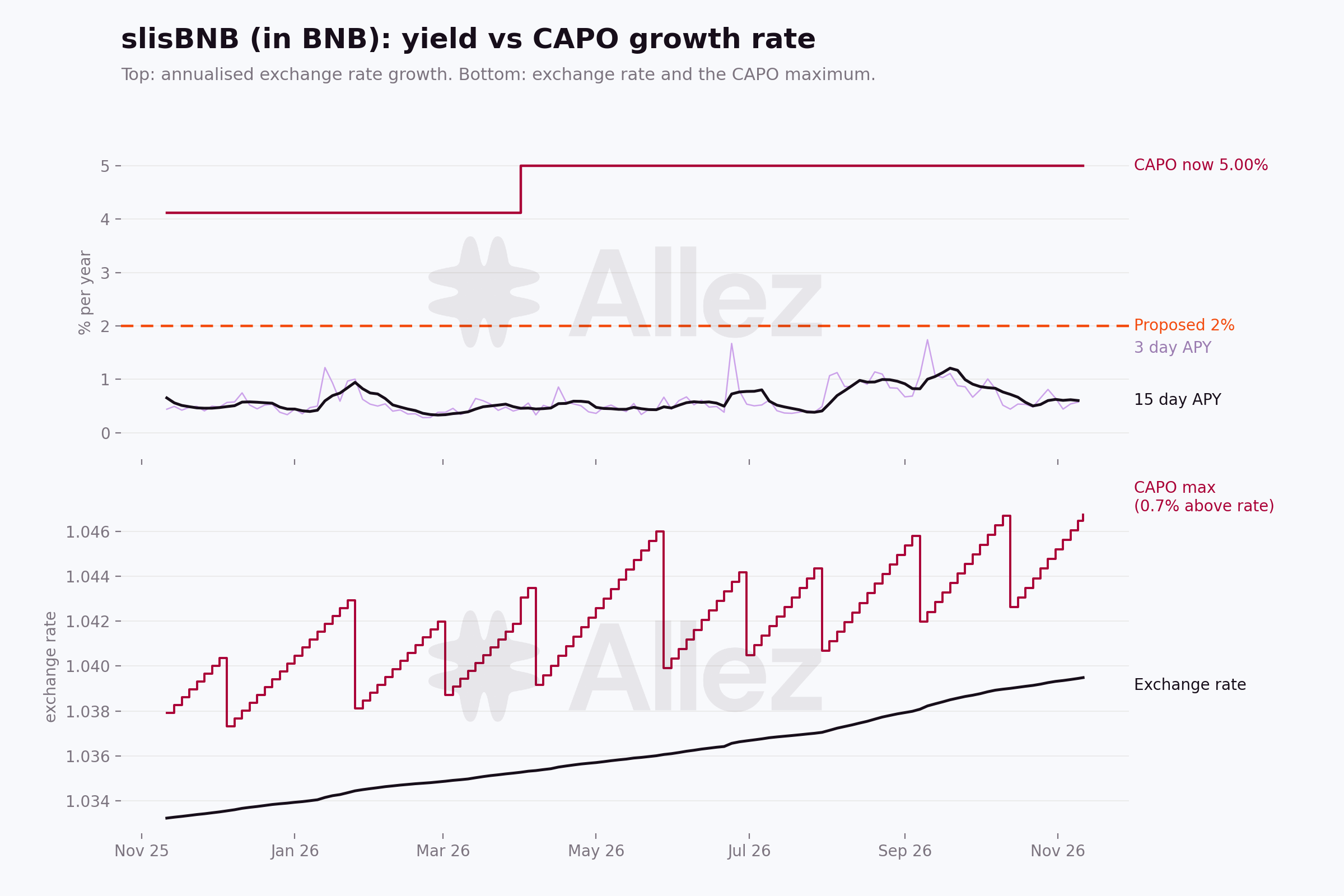
slisBNB yield against the CAPO growth rate, and exchange rate against the CAPO maximum
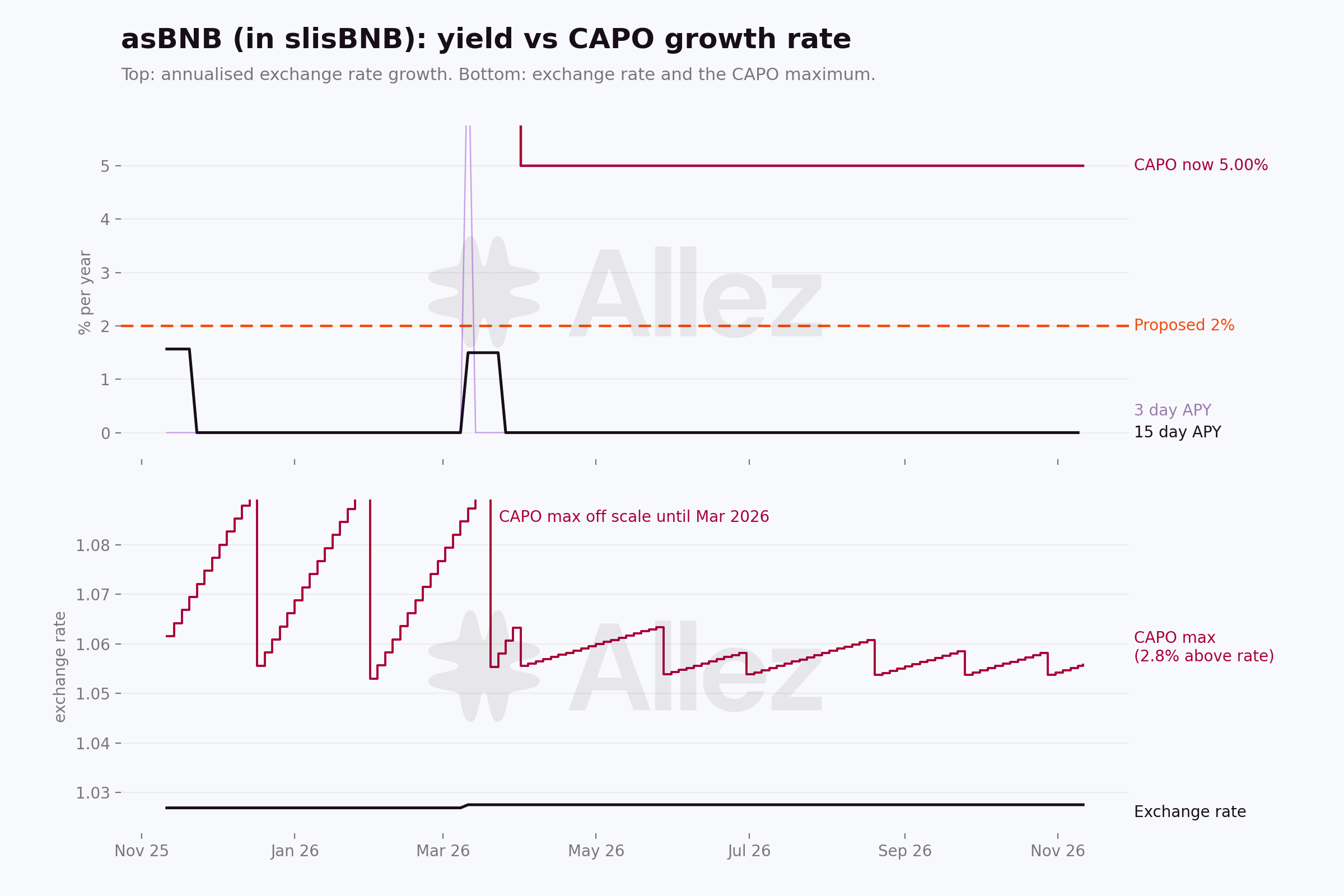
asBNB yield against the CAPO growth rate, and exchange rate against the CAPO maximum
WBETH
WBETH yield has stayed around 2.5% throughout 2026, so the growth rate is now 3%. A brief rise above 3% in early November reverted quickly, and the 15-day yield stayed below 3%. With the new rate, headroom is about 0.4%.
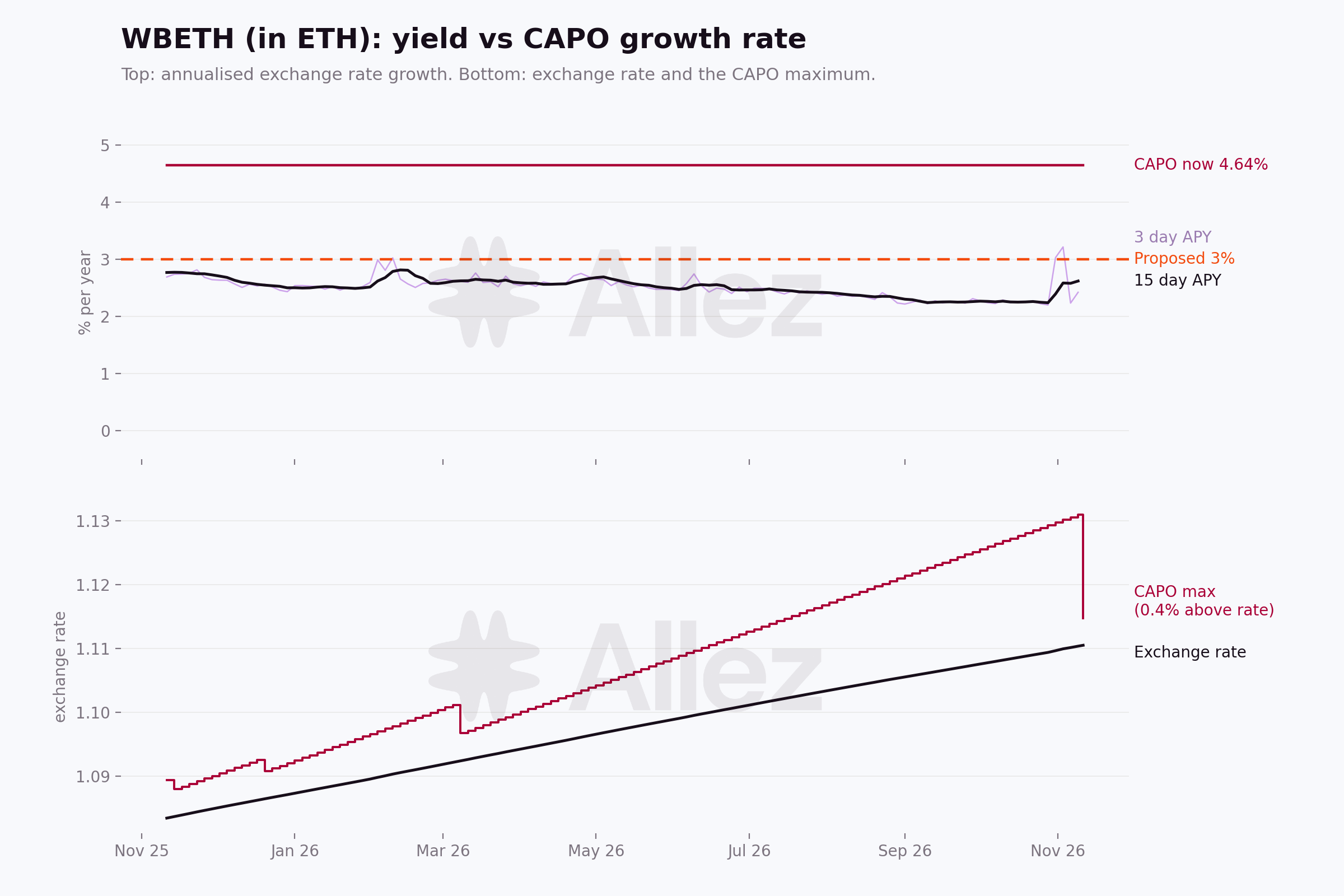
WBETH yield against the CAPO growth rate, and exchange rate against the CAPO maximum
Snapshot refreshes
A snapshot only resets when someone calls updateSnapshot(), which anyone can do once the 30-day interval has passed. We have set up a keeper that refreshes the snapshot on all CAPO oracles every 30 days for redundancy.
Oracles
| Asset | Oracle |
|---|---|
| sUSDe (main) | 0x2b2895104f958e1ec042e6ba5cbfecbad3c5bedb |
| sUSDe (pivot) | 0xa67f01322af8eba444d788ee398775b446de51a0 |
| WBETH | 0x49938fc72262c126eb5d4bdf6430c55189aeb2ba |
| slisBNB | 0xdde6446e66c786aff4cd3d183a908bcda57df9c1 |
| asBNB | 0x652b90d1d45a7cd5be82c5fb61a4a00ba126dde5 |