Venus X powered by Fluid

Summary

Fluid proposes to launch Venus X (final name tbc), which will consist of the lending market and DEX on BNB Chain, powered by Fluid. This upgrade transforms Venus into a safer, more profitable, and future-proof protocol, while keeping the Venus brand and BNB chain distribution intact.

Context

Fluid is a liquidity protocol that reached a $6B TVL in 18 months, merging lending, borrowing, and trading into a unified system. It can support an entire ecosystem of financial products on top of it. Today, we already have two major components live:

  • Fluid Lending offers the highest liquidation thresholds as high as 98%, and the lowest Liquidation Penalties, as low as 0.1%, in the industry. No other protocol can match the risk parameters we’ve engineered, and that translates to better conditions for users.

  • Fluid DEX is the fastest-growing and most capital-efficient on the market. It’s built directly on top of our liquidity layer, which means bootstrapping is much easier and more sustainable. Our goal is to be the largest DEX by volume across all chains combined within the next 6 months.
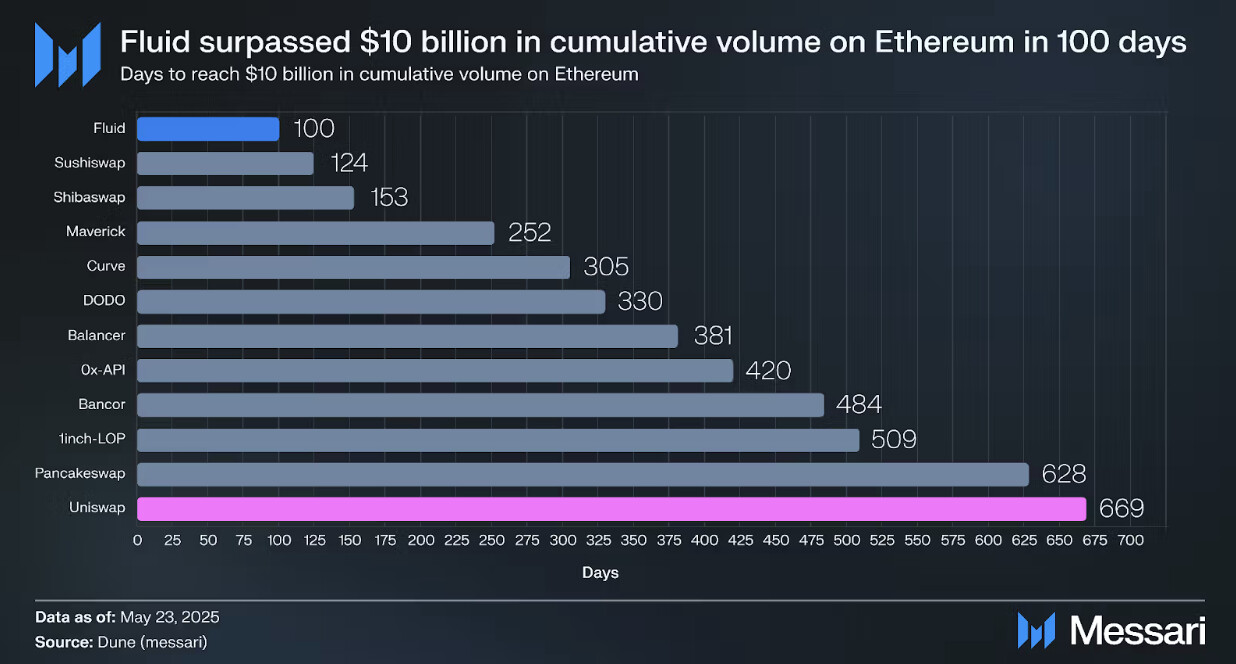
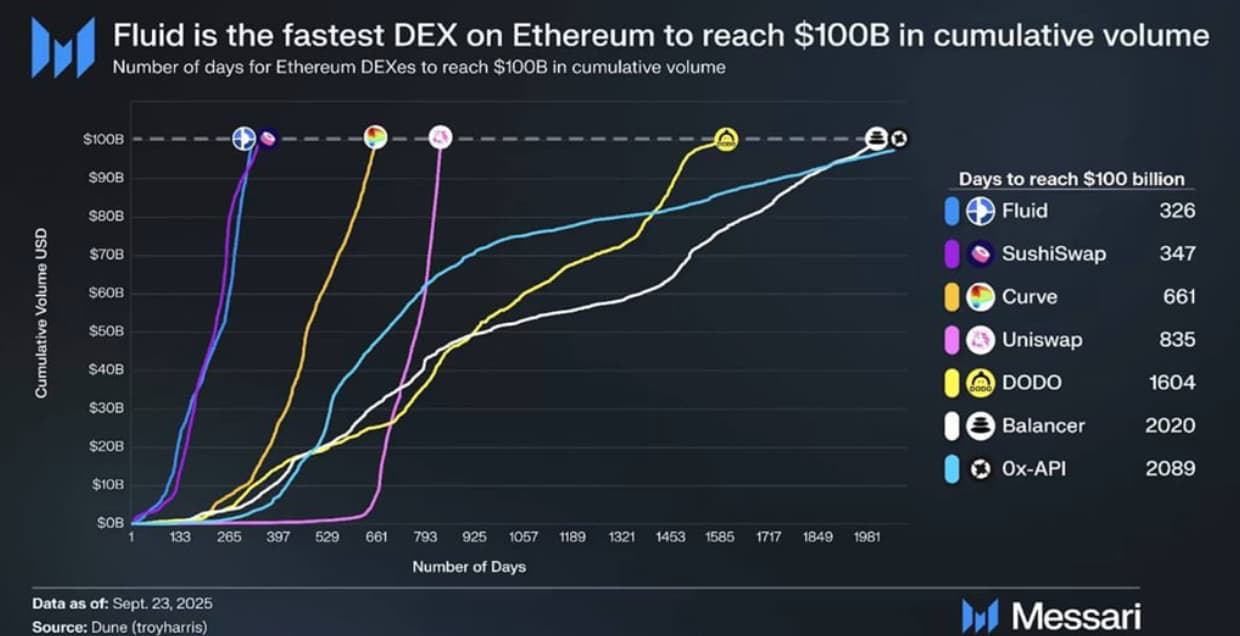
Fluid solves DeFi liquidity fragmentation with a unified architecture that integrates lending, borrowing, and trading into one shared liquidity system. This positions Fluid as the most effective protocol to bootstrap liquidity, users, and volume, while delivering a superior UX.

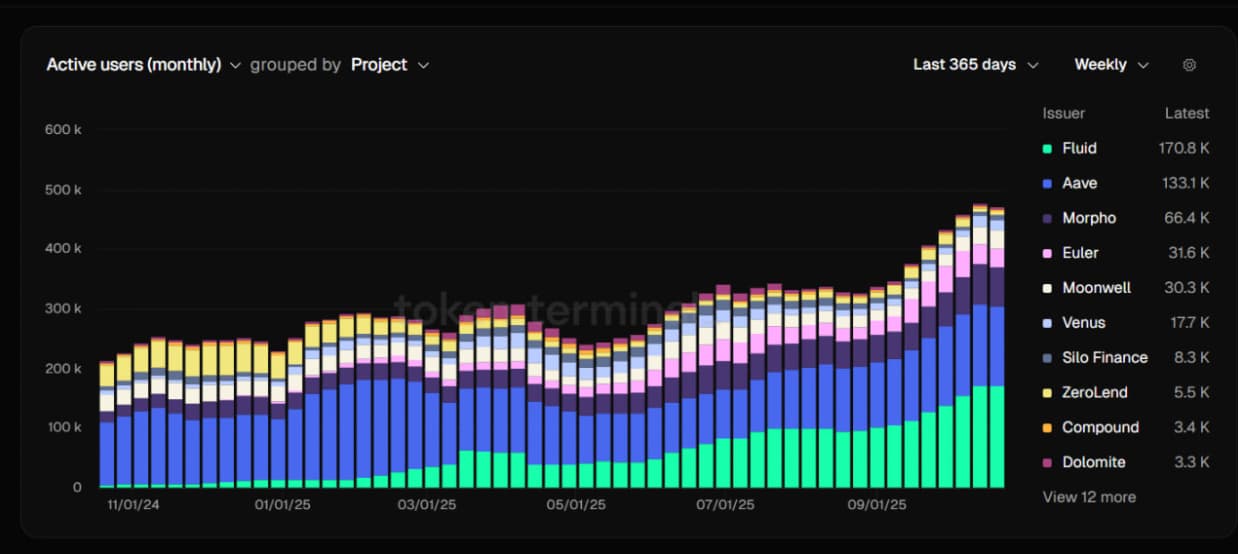
For example, Fluid already has the most users among all lending markets in DeFi.
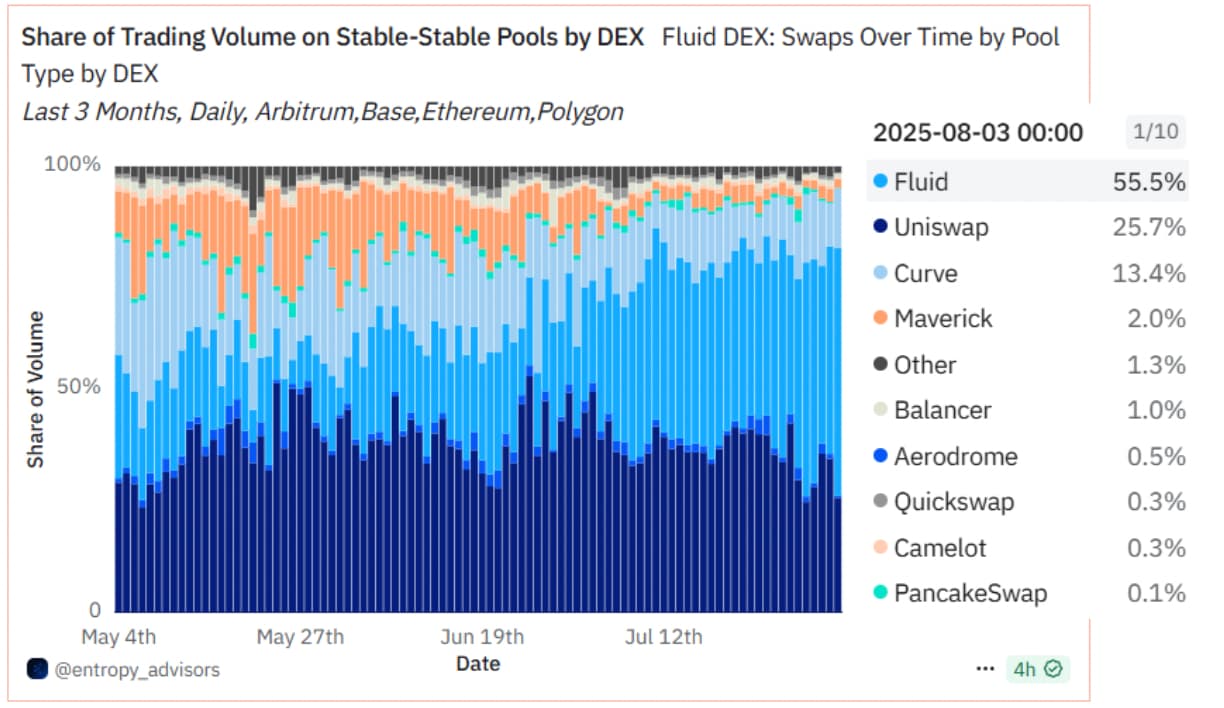
Fluid generates more volume on the correlated pairs on Ethereum, Arbitrum, Base, and Polygon than all other DEXs combined by leveraging debt-based liquidity. We believe Smart Debt will power on-chain Forex, making it ideal for Binance Pay infrastructure.
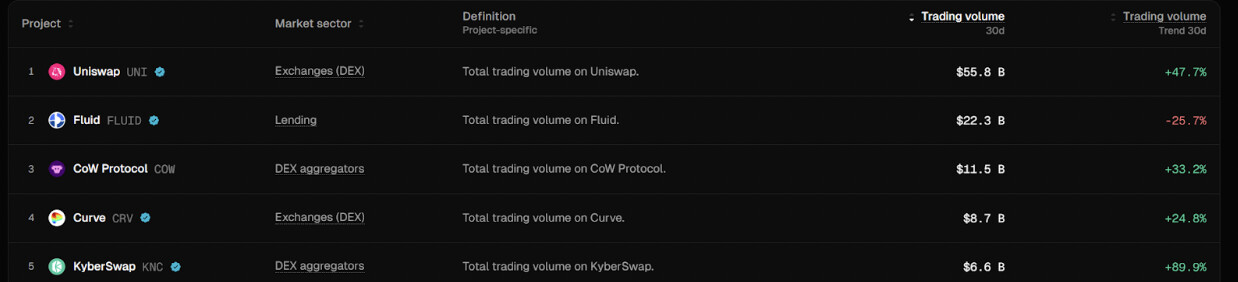
Overall, Fluid is the second biggest DEX by volume on Ethereum, aiming to become the biggest DEX by volume after the DEX v2 launch.
What’s Coming Next

  • We’re not stopping at lending and trading. In fact, we have recently launched the first credit-based protocol on Fluid - uncollateralized borrowing directly from our liquidity layer. This opens up some really interesting potential:

  • Users on BNB could eventually access on-chain credit lines.

  • We could integrate this directly with payment solutions, giving users a more “bank-like” UX while staying fully decentralized.

We’re also working on these protocols, and at least one of them is expected to be launched next year:

  • Permissionless lending markets for institutional and private credit.
  • Fixed rates protocol.
  • A perps market on top of the same liquidity base, meaning more protocol fees and stronger incentives for LPs.

Proposal

  • Fluid will deploy Lending market and DEX smart contracts on the BNB chain under the existing Venus branding.
  • A tier-based revenue split approach that will not reduce Venus DAO revenue.
  • Fluid will maintain and continue developing the technical stack of the protocol.
  • Protocol will implement a dual governance model by XVS and FLUID token holders.
  • Fluid and Venus will provide incentives in a 50:50 proportion for growth initiatives of Venus X on the BNB chain.

Motivation

Venus is the biggest, most popular, and well-known lending protocol in the BNB ecosystem, but it utilizes outdated Compound v2 tech underneath, which can not provide the optimal UX or maximize revenue. Current TVL of Venus on the BNB chain is $2.8B, while the revenue is only ~$5M per year.

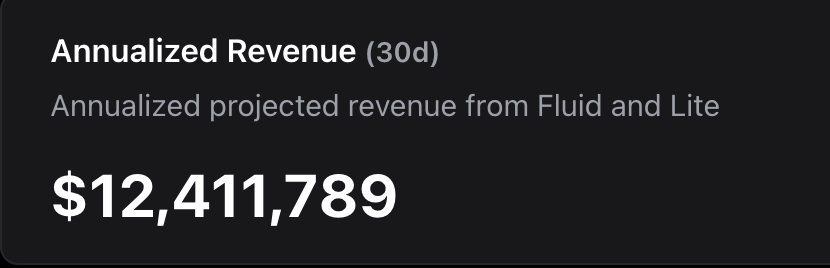
If Venus implements Fluid tech underneath, it will be able to generate more fees, revenue, and attract more TVL via enhanced user experience and more product offerings, such as DEX. For comparison, Fluid earns $12M in revenue on Ethereum with a similar TVL. With the introduction of the DEX v2, we expect to grow the revenue to $100M+ annually, which will significantly increase Venus DAO revenue.
Fluid has already proven the model of combining Fluid’s tech stack with a powerful distribution partner in collaboration with Jupiter. Juplend powered by Fluid, reached $1B TVL in only 8 days after launch.

Conclusion

Why Venus X powered by Fluid, is beneficial for the Venus DAO and BNB chain

  • Battle-tested tech for lending and trading, with more protocols on the way.
  • Extremely high capital efficiency and liquidity reusability.
  • The best infrastructure for Forex markets.
  • An experienced team that’s been in the space for 7+ years, with up to $15B in TVL managed, 4 products launched, and $0 in users’ funds ever lost.
  • Venus DAO will increase its revenue, TVL, and product offerings.
  • BNB chain users will benefit from the better lending UX and DEX liquidity.

Additional resources

https://messari.io/report/understanding-fluid-a-comprehensive-overview

[cyber•Fund | Demystifying Fluid, Part I: Liquidity Layer and Liquidations

2 Likes

Please specify the revenue sharing model for the community :pray:. Is it for the new Venus X thing or are you also expecting anything from our core business? Moreover, it’s important to note that Venus made a lot more money than Fluid this year. I’m not sure where you got your $5M from—please check TokenTerminal for a more accurate source of information.

However, all in all, this is a super bullish proposal, and I fully endorse it, given that the revenue sharing model is fair and square. Welcome to Venus DAO, Fluid :heart:

And thank you Venuslabs for making this possible.

1 Like

Delegate Statement from a group of Major XVS Holders Regarding the Fluid Proposal.

As one of the representative of the largest and longest-standing XVS holders group, our responsibility is to evaluate any proposal through the lens of protocol safety, governance integrity, and long-term value creation for Venus and XVS holders.

The initiative presented by Fluid is ambitious and potentially transformative but, it also introduces governance, technical, and economic implications that must be fully clarified before the Venus DAO can responsibly consider approval.

At this stage, the proposal is incomplete, and several critical details remain undefined. For a protocol of Venus size with over $2.2B TVL, central to the BNB Chain ecosystem, these omissions are unacceptable without further elaboration.

Below are the areas where we deem the community requires full transparency:

1. Governance & Protocol Control

The introduction of a dual governance framework between XVS and FLUID holders is a fundamental change to Venus structure.

Before any vote, Fluid must provide:

  • A precise definition of what powers FLUID governance receives.

  • A clear outline of whether FLUID holders can veto or override XVS decisions.

  • Confirmation that XVS governance retains exclusive, unilateral authority over:

    • Risk parameters
    • Market listings
    • Oracle configurations
    • Incentive programs
    • Upgrades
    • Emergency actions / Guardian functions

The Venus community cannot support any structure that dilutes XVS authority, directly or indirectly.

2. Smart Contract Admin Keys & Upgrade Paths

Integration with Fluid’s stack implies major architectural changes. The DAO must understand:

  • Who controls the admin/owner of deployed Fluid contracts on BNB Chain.

  • Whether Venus retains full, revocable authority over:

    • Pauser/Guardian roles
    • Upgrade mechanisms
    • Deployment rights
  • Whether Fluid can roll out protocol upgrades without Venus DAO approval.

  • The existence of emergency exit mechanisms allowing Venus to disengage without jeopardizing user funds.

For a $2.2B protocol, contract control and revocability are non-negotiable.

3. Economic & Revenue Model Clarity

The proposal outlines a (tier-based revenue model), but no specifics are provided.

The DAO requires:

  • The exact revenue sharing percentages across all tiers.

  • The conditions that determine these tiers.

  • Confirmation that Venus DAO will not earn less than current revenue in any scenario.

  • Complete transparency on:

    • Incentive matching obligations
    • Duration of incentive matching
    • Whether Venus is expected to incentivize FLUID pools or the FLUID token
    • Long-term sustainability without excessive emission requirements

Venus must avoid entering a structure where XVS emissions or DAO revenue become dependent on a third party’s incentives or tokenomics.

4. Risk Architecture, Oracles & Liquidity Exposure

Fluid uses a unified liquidity layer and “smart debt” system. Before adoption, Venus DAO requires:

  • Full explanation of liquidity isolation between Venus markets and Fluid’s other products.

  • Whether Venus users liquidity can be rehypothecated or borrowed against outside the Venus ecosystem.

  • Details on oracle infrastructure and fallback logic.

  • Complete list of audits covering every module proposed for Venus X.

  • Stress test data demonstrating resilience across:

    • Oracle attacks
    • Cascading liquidations
    • Volatility events
    • Chain outages on BNB Chain

Safety remains paramount; unified liquidity introduces unified risk unless clearly segmented and protected.

5. Migration Plan for Existing $2.2B TVL

Switching Venus backend is not trivial. Venus users require:

  • A full migration plan for all existing positions.
  • Clarity on whether migration is automated or user-driven.
  • Guarantees that users will not face liquidation risk during migration.
  • Timing, sequencing, and testnet validation procedures.

A migration of this scale cannot proceed without exhaustive clarity and risk controls.

6. Exit Conditions & Long-Term Independence

Any partnership must include:

  • A clearly defined exit path for Venus DAO.
  • Guarantees preserving Venus independence, brand, and governance authority.
  • Commitments preventing Fluid from launching “Venus X” derivatives or equivalents on other chains without DAO approval.

Venus cannot be placed in a position where returning to independence becomes impossible or financially damaging.

Conclusion & Path Forward

We appreciate the ambition and effort behind Fluid’s proposal. Their technology and growth trajectory warrant serious discussion. However, Venus is not simply a partner, it is the backbone of BNB Chain, and proposals of this magnitude require the highest standards of precision, transparency, and safeguards.

At this time, we cannot support the initiative without comprehensive answers to the above governance, security, economic, and migration concerns.

The DAO must prioritize stability, sovereignty, and safety, above all else. This proposal could be transformational or catastrophic, depending on the fine print. It’s either: A major tech leap for Venus or a disguised takeover giving Fluid control of Venus backend + governance + revenue.

Once all issues are addressed (with exact parameters, not concepts) we are fully open to evaluating a revised and more detailed proposal.

The opportunity is substantial, provided the framework is transparent, secure, and aligned with long-term XVS holder interests.

7 Likes

Hi everyone and thank you for your detailed comments. I am glad to see an active community engagement and happy to address all concerns.

Initially, “Venus X powered by Fluid” will be controlled by a shared multisig with a 50:50 representation of both teams, where neither of the teams can make any change to the protocol on its own. Over time, the plan is to shift to the DAO governance for Venus X, which will be controlled by both token holders in equal capacity, with the same principle where neither of the DAOs can solely make any changes to the protocol. Current Venus products remain under 100% XVS governance.

Fluid holders won’t be able to override XVS decisions related to Venus X. Every proposal has to be supported by both DAOs to pass.

As mentioned above, for Venus X, the governance will be shared between the teams/DAOs.

Fluid has no right to make any changes to the Venus X protocol on our own. It will be shared between both teams and/or DAOs.

There will be a legal document between both foundations that will allow parties to disengage in a controlled manner.

Venus DAO stays in full control of an existing $2.2B protocol. Same as Fluid stays in full control over an existing $5B protocol. Venus X will be controlled mutually.

A tiered approach helps us start conservatively, build trust, and show a clear, risk-adjusted path toward a 50/50 split target.

Tier Monthly Net Protocol Revenue Revenue Share
Tier 1 (Baseline) Less than 450,000 USD equivalent The entire amount goes to Venus (baseline revenue protection).
Tier 2 (Growth stage) Between 450,000 and 900,000 USD equivalent Fluid earns from incremental revenue above baseline.
Tier 3 (Mature stage) Equal to or greater than 900,000 USD equivalent 50% to Fluid, 50% to Venus (on revenue exceeding Tier 2 threshold).

$450k value taken as the current 3-month average monthly revenue of the Venus protocol.

Venus and Fluid teams will match any user incentives on a 50:50 basis upon governance approval.

No.

Some of the revenue references are mentioned in the original proposal, but we expect that Venus X will be generating substantially more revenue than Venus within ~6 months after launch.

There is no connection between Venus (and Venus X) markets and Fluid other products.

Assets in the Liquidity Layer can be rehypothecated within protocols built on top of it. For more technical information, please refer to the additional sources listed at the end of the original post.

We are undergoing more audits at the moment, they will be shared once completed.

Also, wanted to note that the Fluid protocol is the only lending market on Ethereum that has never had an exploit or a bad debt. Overall, we have been in the space for more than 7 years in the space and we have never had any security or economic breach.

Migration is not forced, users can remain within the existing Venus protocol. We believe that Venus X will provide better conditions to the users and they will want to move to Venus X. We will provide tools for such users to migrate their positions to Venus X in 1 click, with no fees, slippage or any losses.

These points will be fully covered and guaranteed in a legal contract once the DAO approves the proposal.

Overall, we envision Venus X as an equal partnership between Venus and Fluid that will increase revenue, TVL, users, product offerings, etc, for both parties. Neither party has any extractive intentions and we both believe that the collaboration will create a lot of value.

Thank you @DMH for providing a first round of clarifications and engaging constructively with community concerns. The initiative and openness to dialogue are appreciated.

After reviewing your responses, it remains clear that several critical components of the proposal are still conceptual rather than fully specified and I’m afraid XVS holders may actually have more questions now rather than fewer.

To help move the discussion forward constructively, let’s start with some follow-up questions and clarifications regarding Revenue, Tokenomics & XVS Utility.

Several foundational Tokenomic considerations still need to be addressed:

1. Revenue Flows

  • Is revenue generated by Venus X funneled back to the existing Venus protocol, or is it siloed within a new ecosystem?

This distinction directly affects XVS value capture and long-term economic sustainability.

2. Impact on Venus Prime

  • Will Venus X enhance, complement, or partially replace the current Prime utility structure?
  • How does the Prime reward logic translate under a dual-governance model?
  • Are Prime rewards preserved, expanded, or modified?

3. Existing Venus Tokenomics

Venus still has around 14.2M undistributed XVS

  • How does this remaining supply integrate into Venus X?
  • Is it earmarked for incentives, governance, liquidity, or something else?

4. Emissions & Incentive Alignment

  • How much XVS is expected to be emitted to support Venus X incentives?
  • Is there a proposed joint XVS/FLUID emission schedule?
  • What is the projected duration, total spend, and cap on XVS incentives?
  • How do we avoid unnecessary dilution of existing XVS holders?

5. Utility of XVS in Venus X

Co-governance alone does not create value capture.
We need clarity on:

  • How XVS holders benefit economically from Venus X
  • Whether revenue distributions accrue directly or indirectly to XVS holders
  • Whether XVS emissions will dilute current holders and at what rate
  • What new utilities, if any, XVS gains within the Venus X architecture

6. Revenue Distribution Between Tokens

  • How are revenues shared between XVS and FLUID token holders?
    • Direct distributions?
    • Buybacks?
    • Treasury allocations?
    • Emissions or incentive programs?
  • What portion of revenue flows to each group, and through what mechanism?

For clarity, it would be best to present these elements with concrete formulas, parameters, and numerical examples rather than high-level concepts. XVS holders need that level of detail to accurately evaluate the long-term economic impact on XVS and properly assess the sustainability of Venus X.

Looking forward to the next iteration of details so the community can evaluate the proposal with full transparency.

Revenue, emision, use of xvs @fluid and use of fluid @venus should be attended. Also, will venusX keep burning bnb with part of its revenue?
Its all unclear…
Xvs holders (DAO members) will benefit from venus X? How?

As it seems, Venus X will dirrectly compete with Venus… How is that a good idea?

That looks very good. Welcome abroad :smiling_imp:

  1. Brand & UX Ownership
    Will Venus retain full ownership of the product branding, UX, and user flow on the Venus UI without co-branding or dilution?
    2. Revenue Model Transparency
    What is the exact revenue split between Venus and Fluid, and how does this scale with usage?
    3. Impact on Venus Legacy Markets
    How does the new product avoid cannibalizing the existing Venus markets and XVS-based tokenomics?
    4. Risk Isolation
    Are there any technical, financial, or legal risks that XVS holders might be indirectly exposed to through this partnership?
    5. Smart Contract Control
    Who will control upgrades, parameters, and emergency functions of the integrated product?
    6. BNB Chain Alignment
    How does this partnership strengthen Venus’s position on BNB Chain and support long-term sustainability for XVS?
    7. Long-Term Vision
    How does Fluid fit into the multi-year roadmap of Venus? Is this a one-off integration or the foundation for a broader ecosystem expansion?

I agree that there are a lot of undefined areas, especially when it comes to aligning everything with the long-term goals of Venus and XVS holders. But we don’t know the long-term vision of the new team yet; only a soft roadmap has been published.

  1. Would love to see how the revenue sharing and governance works on other networks where Fluid has launched.
  2. Would be great if DMH shares Fluid’s goals and long term vision more clearly, especially about potential revenue from DEX v2 and how it can reshape the current market
  3. Please explain how the responsibility and losses will be shared between two protocols in case of a breach or a fund loss?

At the same time:

  1. Venus hasn’t innovated in years.
  2. We can’t afford to stand still while the world is moving at ultra speed.
  3. Competitors offer a better product, and we can’t do much about it.

While we’re waiting for the AMA, I recommend watching this interview and reading their plans:
https://www.youtube.com/watch?v=zyQvX_Gyc1k (in English after the intro)
Latest Fluid News - (FLUID) Future Outlook, Trends & Market Insights
What I like is that they execute fast and have a clearly defined and very ambitious goal.

I think that giving away 50% of revenue in exchange for the potential to become part of the #1 DeFi protocol is a much better option than keeping 100% of a stagnant and slowly dying protocol with an outdated codebase.

Fluid has ambitions to be #1, and Binance/BNB Chain has the same ambitions. So the long-term future looks bright to me. Combined with the potential income from Fluid’s DEX v2 - which could take a big chunk of Uniswap’s market the offer looks strong. Or at the very least, the future with Fluid’s plans looks much brighter than leaving Venus as is with only e-mode and auto-leverage. We must innovate to stay competitive. Let’s be real, Venus can’t replicate what Fluid did in a reasonable amount of time.

If we think in terms of the next five years, Fluid could become bigger than Aave and Uniswap. Fluid grows constantly and has a clearly defined growth plan. Venus unreleased features are not as unique and don’t guarantee growth. It’s not so easy to ignore the negative consequences of doing nothing. I’m not happy with the past performance of XVS, but we need to move forward and focus on doing what’s best now.

Also relevant to the discussion - you can’t block innovations, if your product is inferior.
Kamino Blocks Jupiter Lend Refinancing (3 December 2025)
Kamino, Solana’s second-largest lending protocol, manually blocked an address tied to Jupiter Lend’s new Refinance tool, preventing users from migrating loans. Critics argue this undermines DeFi’s open-finance ethos, while Kamino’s TVL has dropped 30% since October. Fluid, which provides liquidity to Jupiter Lend, noted Kamino users are locked into low yields.

We can decline the offer, block or ignore the competitors with better products, but users will move to a better place anyway. Launchpool ecosystem has changed and users moved from Venus to Lista, Lista has a bigger TVL right now. Same can happen to Pancakeswap or AAVE without innovations.

2 Likes

It’s “too late” for us to innovate ourself. Even in X, CZ agreed. We must accept their proposal.

I support innovations and like that Fluid has a good track record and very fast growth rate. But the following issues should be discussed:

  1. How the new product will affect XVS holders and Prime users? If TVL flows to the new product it would be unfair that current Prime holders will get nothing from it. Please explain new tokenomics and it’s impact on loyal XVS holders. If Venus X earns XYZ amount of money, how exactly it will benefit XVS holders?
  2. How will the new product affect Venus Classic in the long term? We expect that Venus X will offer better LTV, rates and new innovative products like DEX. We don’t have a roadmap for Venus Classic. Will it gradually become a support-only product with no new innovations?
  3. Fluid aims to be #1 DeFi infrastucture. Am I correct that with the launch of Venus X, Venus will compete with Lista, Pancakeswap, Uniswap - basicaly aims to become #1 Dex and Lending solution on BNB chain? So more revenue and competitors. New tech vs old tech
  4. Will Venus X have a separate marketing budget and risk fund?
  5. Does BNB chain has a long-term vision why would users prefer Fluid on BNB chain, but not on any other chain? Once users get familiar with the tech stack, they may migrate to another chain. Do we have a clear plan how to stay #1? Will there be some new features that are exclusive to Fluid on BNB chain? Right now BNB is very cheap and fast and it is our edge. But other networks improve with time too. Are there any risks that in the future Fluid will nudge users to a different chain, where they control 100% of the product? There may be not so huge difference in fees and speed 5 years from now.
  6. Will Fluid help us with liquidity and auto-buybacks of XVS token? Right now liquidity of XVS token is very low, will it improve with DEX v2?

We need

  1. Roadmap for Venus, will it become obsolete/support only? Which product will get a marketing support?
  2. Fluid’s long-term vision of Venus X on BNB chain. Wouldn’t Venus X compete with Fluid’s main product on other chains? Shouldn’t Venus treasury buy and hold Fluid’s tokens to mitigate this risk? That way regardless of which network wins, revenue will flow into the treasury via buybacks.
  3. Regarding the seamless migration. Is it correct that all tokens from Venus Core pool will be supported on Venus X, including less liquid like XVS?
  4. Fluid’s long-term vision of ecosystem in general and on competitors like AAVE and Uniswap. Tech will improve with time, which aspects will differentiate Fluid from others?
  5. We had issues with Chaoslabs - they spend more time with AAVE and implement new things for AAVE faster than for Venus, set better LTV and risk parameters for AAVE. Wouldn’t the same thing repeat with Fluid’s tech? Discuss internal competition, product cannibalization and conflict of interest.
  6. How will introduction of Venus X affect BNB Burn agreement? Venus had agreed to burn a part of revenue to get more marketing from BNB chain.
  7. Would be nice to get BNBchain’s vision on how this new Venus X product will compete with already established products like Pancaswap, Uniswap and Lista. Healthy competition is good, but we need to see a bigger picture. If Pancakeswap plans to copy Dex V2 or launch something even better soon, then Venus X may not be as successful as promised. We need to understand how all these products will coexist in the future. As an investor who holds XVS for 5 years I want to understand that Venus will remain #1 on BNB chain, even with 50% payment for the innovative tech stack. If Pancakeswap/Lista has plans to build something similar as Fluid’s tech we should know this information and decide accordingly

Please explain why holding XVS token is better than holding FLUID token? Both have buybacks, but FLUID will have the same tech scaled to 10 networks not only BNB. Why would someone hold XVS and not FLUID?

Feedback on the Venus X AMA – Request for Clarification from Venus Labs

I am reposting here feedback that was already shared on the official Telegram channels, but has not received any clear or substantive response so far. Given the importance of the topic, I believe it is appropriate to formally raise these points on the DAO forum as well.

This feedback follows the recent X live, which was presented as an AMA (“Ask Me Anything”).

From a community perspective, it did not function as a true AMA. The community did not have the opportunity to ask questions, and several concerns already raised by XVS holders—both on Telegram and elsewhere—were left unanswered. The discussion felt more like a guided conversation, with limited space for addressing the core governance and economic questions surrounding Venus X.

Strictly based on what emerged during the AMA, and reiterating concerns already raised by the community without receiving clarification, the following issues remain unclear and, in my view, require explicit clarification from Venus Labs:


Final assessment (AMA-based)

:x: Coexistence between Venus Legacy and Venus X: not clarified
Although Venus X will introduce new features and products, it was not explained how Venus Legacy and Venus X are expected to function together without competing for liquidity or users.

:x: Economic model and revenue distribution: not clarified
No clear information was provided on the overall economic structure of Venus X, including how protocol revenues would be allocated across different components (such as reserves, risk funds, incentives, or reinvestment into Venus X itself), nor how these revenue flows would integrate with the existing Venus economic framework.

:x: Benefits for XVS holders: not addressed
There was no clear articulation of how Venus X would translate into tangible value for XVS holders, whether through governance rights, fee capture, incentives, or other explicit mechanisms. The discussion relied primarily on general expectations around TVL growth and ecosystem expansion, without explaining how or if these outcomes would materially benefit existing token holders.

:x: DAO decision-making process: questionable
While it is likely that a vote will eventually take place, it was not clarified how and when the DAO will be meaningfully involved, especially considering that the partnership and a tentative launch timeline have already been publicly announced. This raises concerns about whether governance is being asked to decide upfront or simply to ratify decisions already made.

:white_check_mark: Ecosystem direction: clear
The discussion made it very clear that Venus X is intended to benefit the broader ecosystem, with a strong and repeated emphasis on BNB Chain. However, the focus was primarily on ecosystem-level advantages, rather than on clearly explaining the concrete impact on the Venus protocol itself or for XVS holders.


Request to Venus Labs

Given that Venus X is a strategic initiative for the protocol, and that these points have already been raised within the community without receiving clear answers, I believe it is important for Venus Labs to address them directly and in a structured way, prior to any governance vote.

Clear explanations on coexistence, economic design, value accrual, and the role of the DAO are essential for XVS holders to make an informed decision.

1 Like